How a Grumpy Sloth Became My Latest Book Project
The story behind Sid, a permanently unimpressed sloth, and my latest adventure in creating a humor book.
Some people create books to inspire others.
Some write to share their knowledge, teach valuable lessons, or help readers become better versions of themselves.
And then there’s me.
I created a sloth who thinks Mondays are a design flaw, considers networking a form of unnecessary suffering, and firmly believes that most meetings could be replaced by absolutely nothing.
His name is Sid.
And somehow, this grumpy little creature became my latest book project.
I’m not entirely sure Sid would appreciate the attention.
He’d probably complain that being the main character of a book sounds suspiciously like having a job.
But here we are.
It Started With a Very Grumpy Sloth
I’ve always enjoyed characters with a little personality.
Not necessarily the cheerful, energetic, everything-is-wonderful kind.
Sometimes, the most entertaining characters are the ones who look at the world and seem completely unimpressed by what they see.
And Sid is definitely one of those.
He’s a three-toed sloth with permanently tired eyes, a slightly grumpy expression, and absolutely no ambition to become more productive.
He doesn’t want to change the world.
He doesn’t want to find his purpose.
And he certainly doesn’t want to attend a motivational seminar about unlocking his full potential.
He would much rather be left alone.
Preferably somewhere comfortable.
With no appointments.
The more I developed his personality, the more possibilities I could see.
What would Sid think about working in an office?
What advice would he give someone struggling with Monday mornings?
How would he handle relationships, social obligations, or the pressure to be successful?
The answers were rarely helpful.
But they were usually funny.
And that’s when I began imagining an entire book built around his wonderfully terrible attitude.
Creating a Humor Book Is Surprisingly Serious Work
There’s something rather ironic about creating a humor book featuring a character who hates effort.
Because making a book actually requires quite a lot of it.
There’s the concept.
The writing.
The illustrations.
The layout.
The cover design.
The editing.
And then the editing of the editing.
Followed by that wonderful moment when you notice a tiny detail you somehow missed despite looking at the same page approximately seventy-three times.
At some point, you begin questioning your life choices.
Which is particularly amusing when your main character has been questioning the value of effort since page one.
But I enjoy the creative process.
I like watching an idea slowly turn into something tangible.
A character becomes a personality.
A few funny observations become pages.
Those pages become chapters.
And eventually, there’s an actual book.
Of course, Sid would probably consider the whole process completely unnecessary.
He’d suggest publishing a blank notebook and calling it a day.
Less work.
More profit.
Possibly his best business idea so far.
How to Create a Book Character Who Has Absolutely No Ambition
One of my favourite parts of this project was developing Sid’s personality.
When thinking about how to create a book character, I believe the little details make a difference.
A character needs more than a name and a cute face.
They need a recognizable personality.
A way of looking at the world.
Something that makes readers think, “Oh, that’s exactly what this character would say.”
For Sid, I wanted his personality to be immediately recognizable.
He’s sarcastic.
He’s lazy.
He’s permanently unimpressed.
And he’s remarkably consistent in his refusal to participate in society’s obsession with productivity.
But I didn’t want him to be simply a sloth who complains about everything.
That would become boring rather quickly.
The fun comes from the way he interprets ordinary situations.
Give Sid a motivational quote, and he’ll find a reason to disagree.
Ask him about teamwork, and he’ll wonder why everyone can’t just work separately.
Tell him to chase his dreams, and he’ll probably ask whether the dreams could come to him instead.
And when life gives him lemons?
He leaves them there.
Too much effort.
The challenge was making his personality funny without repeating the same joke on every page.
Because even a character who refuses to do anything needs a little variety.
Unfortunately for Sid, that meant I had to do some actual thinking.
He would not approve.
Writing a Funny Book Isn’t Always Funny
You might imagine that writing a funny book involves sitting at a desk, laughing at your own jokes, and having a wonderful time.
Well, sometimes.
Other times, you write something that seems hilarious in the evening, read it again the following morning, and wonder what on earth you were thinking.
Humor is strange like that.
A sentence can be funny because of one unexpected word.
A joke can work perfectly until you explain it too much.
And sometimes, the funniest response is the shortest one.
With Sid, I wanted the humor to feel natural.
Dry.
A little sarcastic.
Occasionally ridiculous.
But not forced.
I also wanted readers to recognize familiar situations.
The unnecessary meeting.
The awkward conversation.
The Monday morning alarm.
The endless to-do list.
The pressure to be productive even when you’re completely exhausted.
These are ordinary experiences, but they provide plenty of opportunities for humor.
And I think that’s what makes Sid entertaining.
He says the things we occasionally think but probably wouldn’t say during a performance review.
Or at a family gathering.
Or in front of our boss.
Especially in front of our boss.
From a Funny Idea to an Actual Book
Eventually, Sid needed more than a collection of sarcastic thoughts.
He needed a proper book.
A title.
A cover.
A consistent illustration style.
And enough material to justify asking people to spend their money on his questionable wisdom.
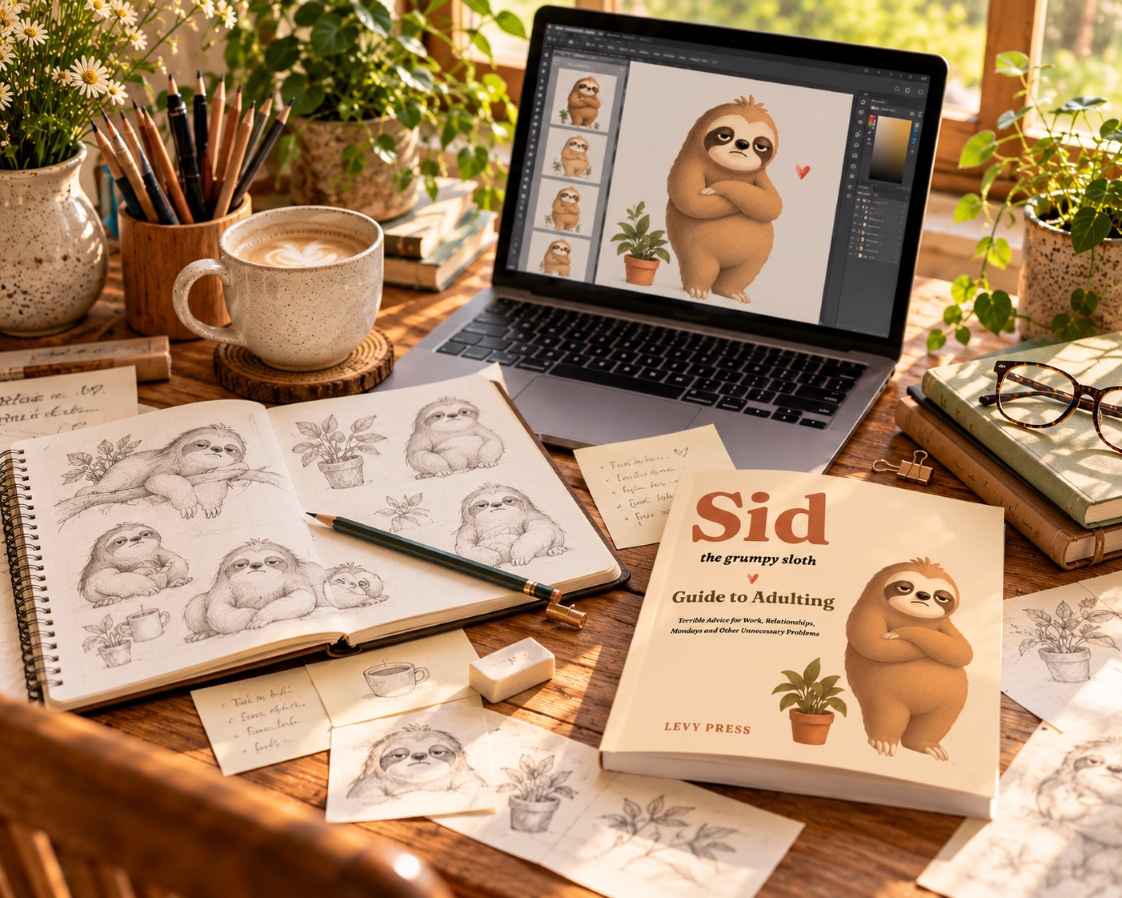
That’s how Sid: The Grumpy Sloth’s Guide to Adulting took shape.
The subtitle seemed particularly appropriate:
Terrible Advice for Work, Relationships, Mondays and Other Unnecessary Problems.
Because let’s be clear: Sid is not qualified to give anyone life advice.
He doesn’t have a successful career.
He hasn’t mastered time management.
And his approach to problem-solving generally involves avoiding the problem until it goes away.
Not exactly the sort of qualifications you’d expect from a self-help expert.
But that’s the joke.
Sid is an anti-self-help character living in a world obsessed with self-improvement.
While everyone else is trying to become more productive, Sid is wondering whether productivity is really necessary.
While motivational speakers encourage people to leave their comfort zones, Sid would like to know why anyone would voluntarily leave somewhere comfortable.
And while the internet is full of advice about becoming your best self, Sid is perfectly satisfied with his current version.
Preferably horizontal.
The Less Glamorous Side of My Self-Publishing Journey
Of course, creating the content is only one part of a self-publishing journey.
There’s also the practical side.
Preparing the manuscript.
Checking the page layout.
Making sure the illustrations look right.
Designing the cover.
Reviewing the final files.
And checking everything again because apparently, trusting yourself after the first review is a dangerous game.
For publishing, I do it through Amazon, which allows independent publishers to prepare and publish their own books.
It’s a useful platform, but it doesn’t magically do the creative work for you.
You still have to make decisions about the book’s format, printing options, cover, description, and presentation.
And there are always small details that need attention.
Sometimes, the most time-consuming part isn’t writing an entire chapter.
It’s moving one illustration slightly to the left.
Then to the right.
Then back to the left.
Before deciding that the original position was probably fine.
I suspect anyone who has worked on a creative project will understand this particular form of suffering.
Sid certainly wouldn’t.
He’d have stopped after the first version.
Actually, he’d probably have stopped before starting.
A Different Side of My Everyday Life
If you’ve been following Chez Thao Hoang, you’ll know that I enjoy sharing little pieces of everyday life.
Cooking something homemade.
Trying a new recipe.
Working in the garden.
Travelling.
Or simply enjoying a quiet afternoon with a cup of coffee.
But there’s another side of my daily life that doesn’t always appear in those stories.
The creative projects.
The writing.
The designing.
The hours spent turning ideas into books.
And sometimes, the rather ridiculous conversations I have in my head while deciding what a fictional sloth should say about office meetings.
It’s a strange combination, I know.
One moment, I’m thinking about what to cook for dinner.
The next, I’m wondering whether Sid would consider replying to emails an unreasonable violation of his personal freedom.
For the record, he absolutely would.
But I enjoy having different creative interests.
Some projects are practical.
Some are educational.
And some exist simply because they make me laugh.
Sid definitely belongs to the third category.
Not everything we create needs to have a serious purpose.
Sometimes, making something funny is reason enough.
Why I Think We All Need a Little Sid Sometimes
I recently wrote another reflection called Adulthood Is Overrated (And Apparently, Even a Sloth Knows It).
It was about the strange expectations of growing up, the endless responsibilities of everyday life, and our obsession with being productive.
And I think that’s why Sid fits so naturally into these thoughts.
Life can be complicated enough without treating every small problem like a national emergency.
Sometimes, we need to laugh at ourselves.
At our endless to-do lists.
At our attempts to organize everything.
At the ridiculous expectations we place on ourselves.
And at the fact that, despite all our planning, we still occasionally forget why we walked into the kitchen.
Sid doesn’t offer solutions.
He doesn’t promise to transform your life.
He certainly doesn’t have a five-step plan for success.
But he might make you laugh.
And after a long day, that’s not such a bad thing.
So, Meet Sid!
After all the writing, illustrating, designing, checking, and occasionally questioning my own sanity, the book is finally here.
This post contains affiliate links. I may earn a small commission from qualifying purchases at no additional cost to you.
📖 Sid: The Grumpy Sloth’s Guide to Adulting
Terrible Advice for Work, Relationships, Mondays and Other Unnecessary Problems
Published by Levy Press.
It’s a lighthearted humor book filled with sarcastic observations about work, relationships, money, Mondays, and all the other unnecessary complications of adult life.
If you enjoy dry humor, slightly grumpy characters, and jokes about the absurdity of modern society, Sid might be your kind of sloth.
You can discover Sid’s book on Amazon and see what this permanently unimpressed little creature has to say.
Just don’t expect him to thank you.
Gratitude requires effort.
And Sid has very strict policies about that.
One Last Thought
Creating this book reminded me why I enjoy working on personal projects.
There’s something satisfying about starting with a small idea and gradually turning it into something real.
Even when the process takes longer than expected.
Even when you have to redo things.
Even when your fictional main character would strongly advise against making so much effort.
And perhaps that’s the funniest part of this entire project.
I spent all this time and energy creating a character whose main philosophy is to avoid spending time and energy.
The irony is not lost on me.
Anyway, Sid is officially out in the world now.
And I’m rather pleased about it.
Sid, on the other hand, has requested that I stop talking about him.
Apparently, he’s trying to rest.
Again.
— Chez Thao Hoang
P.S. If Sid ever writes a second book, I’m fairly certain he’ll expect me to do all the work.
Which, come to think of it, is exactly what happened with the first one.