Collioure: Where the Mountains Meet the Mediterranean
Some places are beautiful because of one spectacular monument or one extraordinary view.
Collioure is different.
It is beautiful almost everywhere you look.
The colour of the houses. The little fishing boats rocking in the harbour. The church standing right beside the sea. The narrow streets climbing away from the waterfront. The mountains appearing behind the rooftops.
And then there is the light.
Perhaps that is what I remember most.
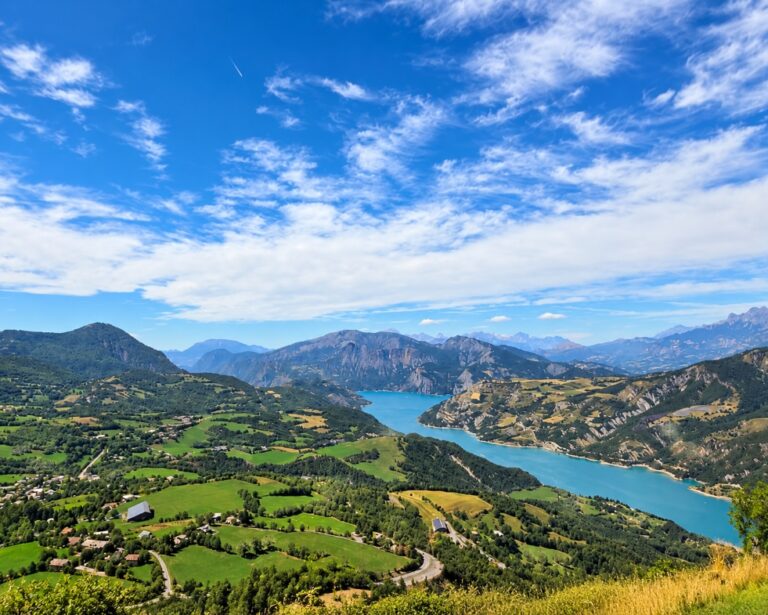
Collioure sits on the Côte Vermeille, in the south of France, not far from the Spanish border, where the Pyrenees seem to tumble directly into the Mediterranean.
It is the kind of place that makes you slow down without really deciding to.
You arrive thinking you are going to explore a village.
And then you find yourself sitting beside the water with a coffee, watching the boats and wondering why you were ever in such a hurry.
A Village Made of Colour
The first thing you notice in Collioure is colour.
Soft pinks, terracotta, ochre and yellow cover the façades around the harbour. Green shutters sit beside blue ones. Bougainvillea and other Mediterranean plants spill over balconies.
Then there is the sea — sometimes turquoise, sometimes deep blue — and behind everything, the green and brown hills of the Pyrenees.
It almost looks painted.
Which, as it turns out, is rather appropriate.
At the beginning of the 20th century, artists including Henri Matisse and André Derain came to Collioure and were inspired by its extraordinary light and colours. Their work here became closely associated with the development of Fauvism.
Today, you can follow the Chemin du Fauvisme, where reproductions of paintings are placed around the village near some of the scenes that inspired them.
But even if you know absolutely nothing about art, you understand why painters wanted to stay here.
Every corner seems to offer another composition.
A red boat against blue water.
Laundry hanging between warm-coloured houses.
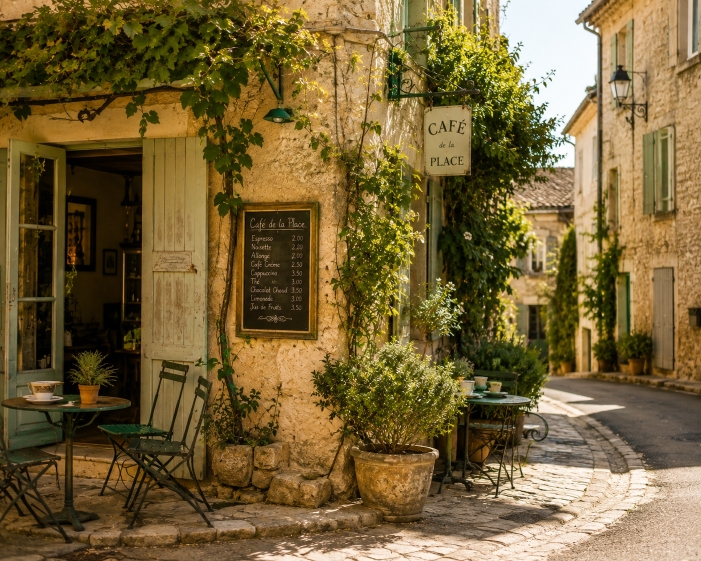
A café table beneath a striped awning.
A doorway framed by flowers.
You don’t really need to look for beautiful things in Collioure.
They keep finding you.
Walking Without a Plan
My favourite way to discover French villages is usually the simplest one:
Walk.
No complicated itinerary.
No list of twelve things that must be seen before lunch.
Just start somewhere and see where the streets take you.
Collioure is perfect for this.
Leave the harbour and wander into the old streets. Some are narrow and shaded, others suddenly open onto bright views of the Mediterranean.
There are little boutiques, galleries, cafés and restaurants tucked between colourful houses.
And every now and then, through a gap between buildings, you catch another glimpse of the sea.
These are often the moments I love most when travelling.
Not necessarily the famous monument everyone photographs.
Just a beautiful corner discovered accidentally.
A chair outside someone’s house.
A cat sleeping in the shade.
An old wooden door.
A small staircase covered in plants.
Those details somehow tell you more about a place.
The View Everyone Remembers
Of course, there is one view in Collioure that is almost impossible to miss.
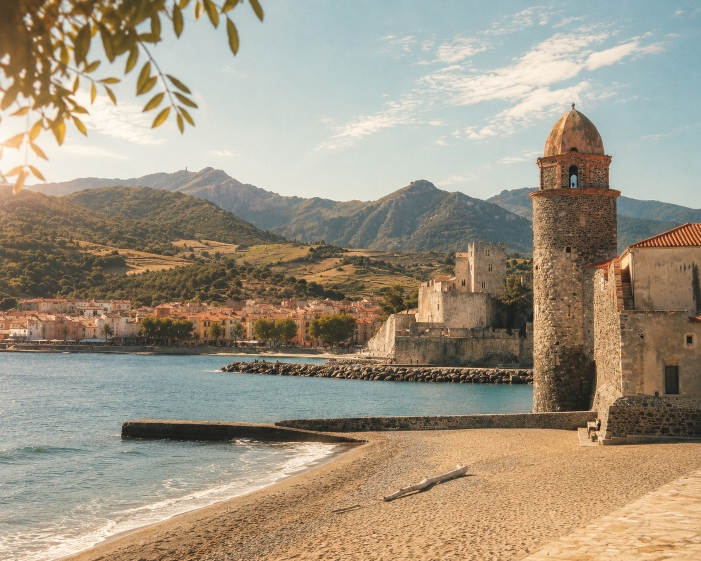
The Église Notre-Dame-des-Anges stands directly beside the Mediterranean, its distinctive bell tower rising above the water.
It has become one of the symbols of Collioure.
Walk around the harbour and the view changes constantly.
From one side, you see the church framed by colourful houses.
From another, fishing boats float in front of it.
Later in the day, the light becomes softer and the whole waterfront seems to change colour.
Nearby, the imposing Château Royal de Collioure reminds you that this peaceful-looking seaside town also has a long and complicated history.
But what I like most is how naturally everything sits together.
Castle.
Church.
Houses.
Boats.
Beach.
Mountains.
Nothing feels separated into a special “historic area.”
The history is simply part of the landscape.
Stop for Lunch — Slowly
Eventually, walking around Collioure leads to another important activity.
Eating.
This part of southern France has a strong Catalan identity, and Collioure has its own famous speciality: anchovies.
Anchovies have been prepared and salted here for centuries, and the traditional Anchois de Collioure are protected by a geographical indication.
Even if you normally think of anchovies as something that disappears somewhere underneath the cheese on a pizza, it is worth trying them properly here.
Served simply with good olive oil, perhaps alongside peppers, bread and a glass of local wine, they are something completely different.
And this is not a place where I would rush lunch.
Find a terrace.
Have a glass of chilled local wine.
Watch people walking along the harbour.
Then order coffee.
There is always time for coffee.
At least there should be.
Between the Sea and the Vineyards
One of the things that makes Collioure so special is its landscape.
This is not the wide, flat Mediterranean coast you find in some parts of southern France.
Here, the mountains are always close.
The hills rise almost immediately behind the town, covered in Mediterranean vegetation and vineyards planted on steep terraces.
The vineyards produce wines under the Collioure appellation, while neighbouring Banyuls is famous for its sweet fortified wines.
Seeing vines growing on these steep slopes makes you appreciate the landscape — and the work behind every bottle — a little differently.
If you have more time, explore beyond the village itself.
Walk part of the coastal paths, visit nearby Port-Vendres or continue along the Côte Vermeille towards Banyuls-sur-Mer.
This coastline becomes increasingly dramatic as you travel south.
Sea on one side.
Mountains on the other.
And Spain waiting just beyond them.
The Best Time to See Collioure
Collioure is understandably popular, particularly in summer.
If you visit during the warmer months, I would arrive early.
There is something lovely about seeing a village before the day becomes busy.
The cafés are just opening.
Shopkeepers are arranging things outside.
The streets are quieter.
The Mediterranean morning light is softer.
And you can wander without feeling that you need to move with a crowd.
Late afternoon and evening have their own charm too.
When the strongest heat disappears, people return to the streets and terraces. Families walk beside the water, restaurants begin preparing for dinner and the harbour takes on a completely different atmosphere.
If you have the choice, spring and early autumn can be wonderful times to explore the Côte Vermeille, when the weather can still be beautiful but the rhythm is gentler than at the height of the summer holidays.
A Small Practical Note
Collioure can become very busy in summer, and driving directly into the centre is not always the most relaxing way to begin your visit.
If you are coming during high season, check parking and transport options before you leave and be prepared to walk a little.
Comfortable shoes are useful too.
The old streets are made for wandering, and once you start exploring, you may walk much farther than you expected.
Bring water in summer, a hat, and — most importantly — don’t plan every minute.
Collioure is much better when you leave some empty space in the day.
Why Collioure Stayed With Me
There are villages you visit because you want to see something.
And there are villages where simply being there becomes the reason for going.
Collioure belongs to the second kind.
You can visit the castle.
Follow the Fauvist painters.
Walk along the coast.
Explore the little streets.
Taste the anchovies.
Swim in the Mediterranean.
But you can also do almost nothing.
Sit beside the harbour.
Drink a coffee.
Watch the boats.
Wait for the light to change.
Maybe that is why artists have been drawn here for so long.
Collioure reminds you that sometimes a place doesn’t need to entertain you.
Sometimes it is enough to give you a beautiful place to sit and the time to notice it.
And perhaps that is my favourite kind of travel.
✈️ Curious what a trip like this would cost? I made a little budget calculator for exactly that — take a look here.