Growing Guavas in France: My Brazilian Guava Variety
There is something special about growing a fruit tree that reminds you of home, especially when that home is thousands of kilometres away. And there is an even greater satisfaction when you finally get to harvest its fruits.
Here in the South of France, our garden is filled with plants that bring us joy throughout the seasons. Some are typical of the Mediterranean climate, while others are a little more unusual.
One of those is my guava tree, a Brazilian variety of the familiar tropical fruit that I grew up knowing in Vietnam.
Growing guavas in France might not be the first thing that comes to mind when you think about gardening in Provence. But that is exactly what makes it interesting.
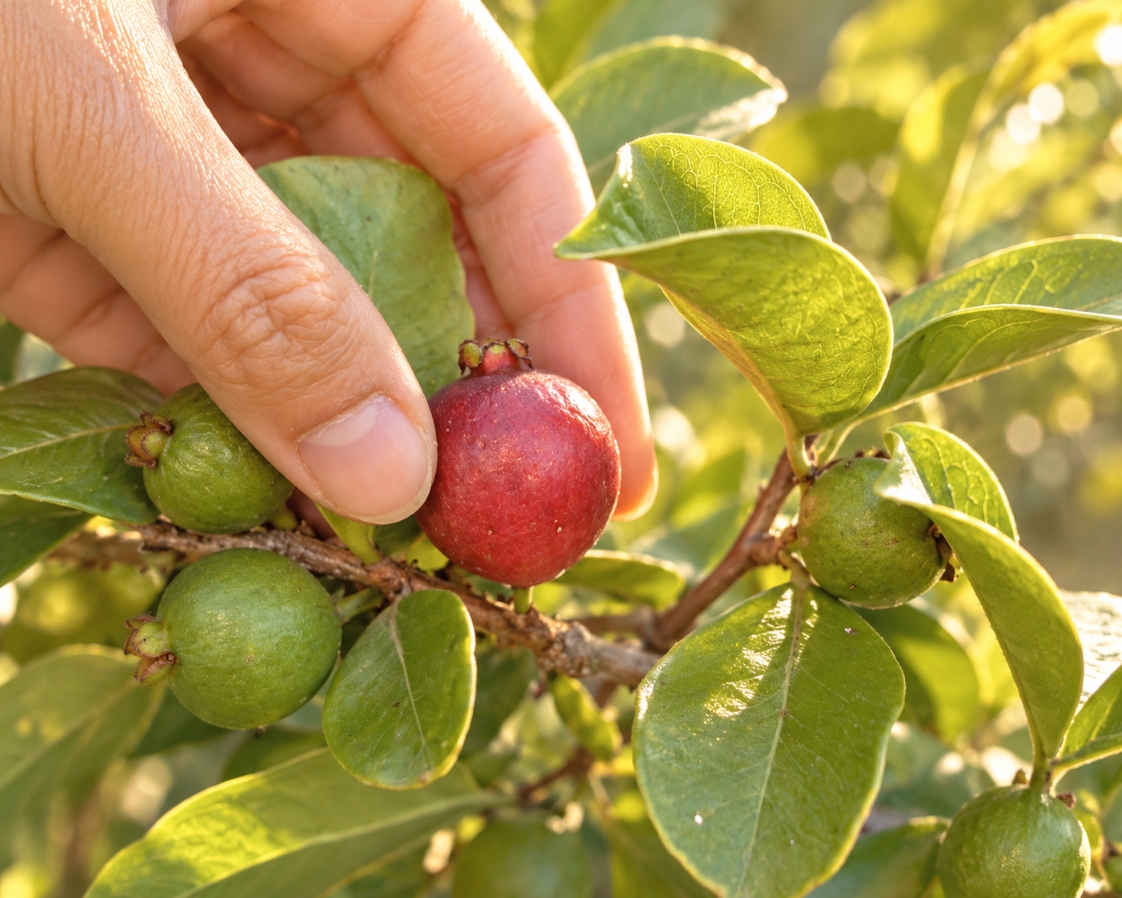
And this year, I had the pleasure of harvesting guavas from my own garden!
After watching the fruits develop among the beautiful green leaves, it was finally time to pick them.
At Chez Thao Hoang, gardening is not just about producing fruits and vegetables. It is about experimenting, learning, enjoying nature, and appreciating the simple pleasures of growing our own food.
And this little guava harvest is another lovely reminder of why I enjoy gardening so much.
A Little Piece of Vietnam in My French Garden
Growing up in Vietnam, tropical fruits were a familiar part of everyday life.
Guavas, mangoes, papayas, and many other fruits were simply part of the food culture around us.
Now, living in France, I find it particularly enjoyable to grow plants that remind me of those familiar flavours.
My guava tree is a Brazilian variety, but guava itself is a fruit I have known since childhood.
There is a lovely connection between the two places.
A garden in Provence, with plants that bring back memories of Vietnam.
I think that is one of the wonderful things about gardening. Our gardens can reflect our experiences, our memories, and the different places that have been part of our lives.
Sometimes, a plant is more than just a plant.
It can also be a little reminder of home.
And being able to harvest guavas here in France makes that connection even more special.
What Is My Brazilian Guava Variety?
Guava, scientifically known as Psidium guajava, is a tropical fruit tree cultivated in many warm regions of the world.
There are numerous cultivated varieties of guava, with differences in fruit size, shape, flavour, skin colour, and flesh colour.
Some produce white-fleshed fruits, while others have pink or reddish flesh.
My tree is a Brazilian variety of guava, rather than a separate botanical species.
Brazil has a long history of cultivating guavas, and different varieties are grown for their fruit characteristics.
Although guavas are usually associated with tropical climates, they can also be cultivated in suitable subtropical environments.
Growing them in France requires some attention to local conditions, particularly during the colder months.
But for someone who enjoys experimenting with fruit trees, that is part of the adventure.
Growing Guavas in the South of France
One of the advantages of living in Provence is the amount of sunshine we enjoy.
Our summers are often long, hot, and dry, which can provide favourable growing conditions for many warmth-loving plants.
However, the Mediterranean climate also presents challenges.
Summer temperatures can become very high, while winter nights may occasionally bring frost.
This is especially important when growing tropical fruit trees.
Guavas generally appreciate warmth and sunshine, but they are not as tolerant of freezing temperatures as many traditional Mediterranean fruit trees.
The Royal Horticultural Society provides useful information about growing common guava, including its preference for warmth and protection from cold conditions.
For gardeners interested in growing guavas in France, choosing a suitable location and planning for winter protection are important considerations.
A sunny, sheltered position can help provide a favourable growing environment.
And as with many plants, observing how the tree responds to the local climate is often the best way to understand its needs.
From Tiny Fruits to This Year’s Guava Harvest
One of my favourite things about having fruit trees is watching the fruits develop.
At first, there are flowers.
Then, if pollination and growing conditions are favourable, tiny fruits begin to appear.
Slowly, they become more noticeable among the leaves.
On my guava tree, the fruits grew among the beautiful green foliage, almost hidden between the branches.
I enjoyed checking on them whenever I spent time in the garden.
Sometimes, the changes were so small that I hardly noticed them.
But after a few days, I would suddenly realise how much the fruits had grown.
And eventually, the moment I had been waiting for arrived.
The guavas were ready to harvest!
There is something deeply satisfying about picking fruit directly from a tree you have been caring for.
No matter how big or small the harvest, it always feels like a little reward from nature.
And this time, that reward was a harvest of homegrown guavas right here in France.
Guava Tree Care: Five Useful Growing Tips
If you are interested in growing guava trees, understanding their basic needs can help you provide suitable conditions.
Although requirements vary slightly between varieties, common guava trees generally benefit from the following care.
1. Give Your Guava Tree Plenty of Sunshine
Guava trees grow best in warm conditions with plenty of sunlight.
A sunny position encourages healthy growth and supports flowering and fruit development.
In Mediterranean regions, it can also be helpful to choose a location sheltered from strong winds.
Young trees may need time to adapt to particularly intense summer conditions.
2. Water Regularly During the Growing Season
Water is especially important while the tree is establishing itself and developing fruit.
During hot Provençal summers, soil can dry out quickly.
However, watering should always take the soil conditions into account.
Guava trees benefit from adequate moisture but generally do not tolerate constantly waterlogged roots.
Rather than watering automatically every day, check the soil and adjust according to the weather and the plant’s needs.
3. Make Sure the Soil Drains Well
Good drainage is essential for healthy root development.
Guava trees can grow in different soil types, but prolonged waterlogging can cause problems.
If you grow your guava tree in a container, make sure the pot has drainage holes.
For trees planted in the ground, avoid locations where water regularly accumulates.
4. Protect Your Guava Tree From Frost
This is one of the most important considerations when growing guavas in France.
Although Provence enjoys relatively mild weather compared with many other French regions, freezing temperatures are still possible.
Common guava trees can suffer cold damage, especially when young.
Container-grown plants can be moved into a bright, frost-free location during winter.
For trees growing directly in the ground, winter protection may be necessary.
The amount of protection depends on the tree’s age, the variety, and local temperatures.
5. Be Patient With Fruit Development
Like many fruit trees, guavas need time to develop and ripen.
Temperature, sunlight, water availability, and the tree’s overall health can all influence fruit production.
Some growing seasons are more productive than others.
And sometimes, even when we do everything we can, nature has other plans.
That is simply part of gardening.
For more detailed growing information, the University of Florida IFAS Extension provides a useful guide to common guava cultivation.
Harvesting My Homegrown Guavas
After watching the fruits grow and develop, harvesting them was definitely one of the most enjoyable moments.
There is something wonderful about reaching into the branches and picking fresh fruit straight from your own tree.
For many common guava varieties, the skin gradually changes from dark green to a lighter green or yellowish colour as the fruit matures.
Ripe guavas may also develop a stronger fragrance and become slightly softer.
However, these characteristics vary depending on the variety.
Some guavas are enjoyed while still firm and crunchy, while others are preferred when fully ripe and aromatic.
In Vietnam, guavas are often eaten while still crisp, sometimes accompanied by a little salt or a savoury seasoning.
For me, harvesting guavas from my own garden in France is a particularly satisfying experience.
It brings together the pleasure of growing my own food and the familiar memories of a fruit I have enjoyed since childhood.
And of course, nothing compares to the satisfaction of enjoying something you have grown yourself.
The Pleasure of Homegrown Guava
There is something different about eating fruit that comes from your own garden.
It is not necessarily about producing large quantities.
Sometimes, a small harvest is enough to make you happy.
When you grow your own fruit, you experience everything that happens before it reaches your kitchen.
You watch the tree grow.
You notice the flowers.
You wait for the fruits to appear.
You check their progress.
And eventually, you get to enjoy the results.
Fresh guavas can be eaten on their own or used in a variety of recipes, depending on their ripeness and flavour.
For me, the real pleasure is not only in eating the fruit.
It is knowing that it grew right here in our garden.
Why I Enjoy Growing Unusual Fruit Trees
I have always enjoyed experimenting with plants.
Some are easy to grow.
Others need a little more attention.
And a few turn out to be much more challenging than expected.
But that is what makes gardening interesting.
Growing unusual fruit trees allows us to learn about different plants and discover what is possible in our own climate.
Not every experiment succeeds.
And that is perfectly normal.
Sometimes, a plant thrives beyond our expectations.
Other times, we have to adjust our approach or accept that certain conditions are simply not suitable.
Gardening is a continuous learning process.
My Brazilian guava variety is another example of why I enjoy trying something different.
And having the opportunity to harvest its fruits makes the experience even more rewarding.
It brings a little tropical character to our garden in France.
And that makes me happy.
Slow Gardening and the Joy of Simple Things
One of the things I appreciate most about gardening is how it encourages us to slow down.
There is always something to do in a garden.
Watering, pruning, planting, harvesting, or simply pulling out a few weeds.
But there are also moments when the best thing to do is nothing at all.
Just walk around.
Look at the plants.
Notice what has changed.
And enjoy being outside.
Watching the guavas develop on my tree was one of those simple pleasures.
And finally harvesting them was a lovely reward for all that patience.
It reminds me that not everything needs to happen quickly.
Some things are worth waiting for.
And sometimes, the most satisfying moments are the smallest ones.
A new flower.
A tiny fruit.
A branch full of fresh leaves.
Or a handful of freshly harvested guavas.
A Little Tropical Harvest at Chez Thao Hoang
Growing guavas in France may be a little unusual, but that is part of what makes this tree special to me.
It brings together my love of gardening, my memories of Vietnam, and my everyday life here in Provence.
From watching the first tiny fruits appear to finally harvesting them, it has been another enjoyable experience in our garden.
And that is something I truly appreciate about growing our own food.
A harvest does not have to be enormous to be meaningful.
Sometimes, a few fruits are enough to bring a smile.
Because gardening is not always about how much we harvest.
It is about the pleasure of watching something grow, the patience we learn along the way, and the happiness of enjoying the results.
And here at Chez Thao Hoang, those little moments are what make our garden feel like home.
With love from our garden,
Chez Thao Hoang 🌿