
Growing Older, Staying Curious: Why I Created Puzzle Books for Grandparents
Sometimes, looking after our minds can be as simple as picking up a pencil, opening a puzzle book, and giving our brains something interesting to do.
We often hear about the importance of staying physically active as we grow older.
Go for a walk. Eat healthy food. Keep moving. Look after your body.
All very good advice.
But what about our brains?
I’ve always believed that keeping our minds active is just as important as taking care of our physical health. As we age, memory, concentration, and the ability to process information can change. And while we cannot control everything that comes with growing older, I think it’s worth finding little ways to keep our minds curious and engaged.
Affiliate disclosure: As an Amazon Associate, I earn from qualifying purchases. If you buy through my link, I may receive a small commission at no additional cost to you. Thank you for supporting Chez Thao Hoang.
That’s one of the reasons I started creating brain activities for seniors through my publishing brand, Levy Press.
I wanted to make something that older people could enjoy without needing a smartphone, an internet connection, or complicated instructions.
Just a book, a pencil, and a little mental challenge.
And perhaps a pair of reading glasses.
Although, judging by how often I misplace mine, I might need these books myself sooner than expected. 😄
Why Brain Activities for Seniors Matter
Our brains are constantly working, even when we don’t realize it.
Remembering appointments, following conversations, making decisions, solving everyday problems — all these activities involve different cognitive abilities.
As people grow older, some aspects of memory and thinking naturally change. That doesn’t mean older adults should stop learning or challenging themselves.
Quite the opposite.
I believe that curiosity shouldn’t have an expiration date.
Whether someone is 30, 60, or 90, there’s something satisfying about figuring out a problem, learning something new, or finally finding the answer to a question.
The National Institute on Aging discusses the importance of cognitive health and the role that mentally stimulating activities may play in supporting healthy aging.
Of course, solving puzzles isn’t a magical solution to memory loss. Research has not established that ordinary puzzle books prevent dementia or Alzheimer’s disease.
But activities that involve concentration, reasoning, and problem-solving can provide enjoyable opportunities to use different thinking skills.
And personally, I think that’s already a good reason to pick up a puzzle book.
Especially when the alternative is spending another hour scrolling through social media without remembering what we were looking for in the first place.
Guilty as charged. 😅
The Story Behind My Super Mamie Activity Book
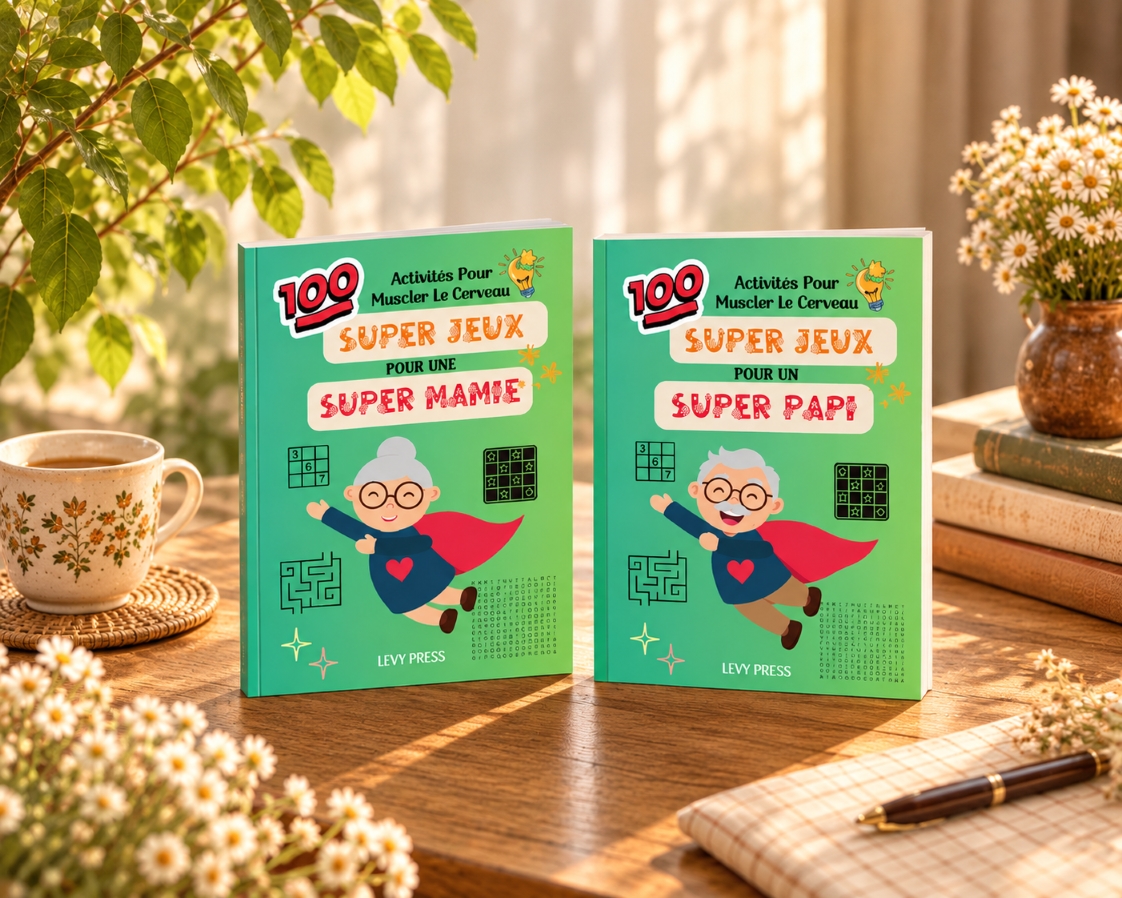
Some time ago, I created a French-language activity book called 100 Super Jeux pour une Super Mamie, published under my Levy Press brand.
The idea came from something simple.
I wanted to create a collection of puzzles that older people could enjoy while giving their minds a little exercise.
Nothing too complicated. Nothing that would feel like schoolwork.
Just a variety of activities that encourage readers to concentrate, observe, think, and solve problems at their own pace.
And because I like adding a little personality and humor to my creations, I decided that an ordinary grandmother simply wouldn’t do.
She needed to be a superhero.
So Super Mamie was born, complete with her red cape, cheerful smile, and superhero outfit.
Because, really, how many grandmothers have spent their lives looking after everyone else, solving family problems, remembering birthdays, and somehow knowing exactly where everything is?
If that doesn’t qualify someone for superhero status, I don’t know what does.
Although I suspect some grandmothers would prefer a quiet afternoon and a cup of tea over another superhero mission. 😂
The book has been part of my Levy Press collection for quite some time now.
And for a while, Super Mamie was perfectly happy being the only superhero grandparent on the bookshelf.
Until I started thinking about someone else.
A New Release: Super Papi Finally Joins the Collection
One day, I realized something rather obvious.
If Mamie has her own activity book, why shouldn’t Papi have one too?
After all, grandfathers have brains that deserve a little exercise as well.
And let’s be fair, some grandfathers take their puzzles very seriously.
Give them a Sudoku grid, and suddenly the entire household needs to remain silent because Papi is conducting important mathematical research.
Never mind that he’s been staring at the same empty square for fifteen minutes. 😄
So I decided it was time to give Super Mamie some company.
And that’s how my newest release, 100 Super Jeux pour un Super Papi, came to life.
Just like Super Mamie, Super Papi has his own superhero cape, cheerful personality, and collection of 100 activities designed for enjoyable mental stimulation.
Both books are published through Levy Press, my independent publishing brand.
I love seeing the two books together.
They look like a little superhero team.
One that doesn’t need to save the world.
Just solve a few puzzles before dinner.
And perhaps argue about who finished their Sudoku first.
Simple Memory Activities for Seniors to Enjoy
When creating these books, I wanted to include different types of puzzles rather than filling every page with the same activity.
After all, variety makes things more interesting.
Both Super Mamie and Super Papi contain 100 activities, including several types of games.
Number Sudoku: A Little Challenge for Logical Thinking
Sudoku is one of those activities that looks simple until you actually sit down and try to solve it.
You have a grid, some numbers, and a set of rules.
How difficult could it possibly be?
Well, sometimes very difficult, apparently.
Number Sudoku encourages logical reasoning, concentration, and attention to detail.
It’s also satisfying when everything finally falls into place.
That little moment when you find the missing number?
Wonderful.
Until you realize you’ve put a 7 in the wrong square twenty minutes earlier.
Picture Sudoku: A Different Way to Think
I also included Sudoku puzzles using pictures and symbols instead of numbers.
These offer a playful variation on the traditional game.
The principle is similar: observe the grid, recognize patterns, and work out where each symbol belongs.
I particularly like this type of puzzle because it makes Sudoku feel a little different.
And sometimes, a change of format is all it takes to make an activity more enjoyable.
Mazes: Finding Your Way Through
Mazes are another favorite.
The goal is simple: find the correct path from the starting point to the finish.
But as anyone who has ever tried a complicated maze knows, the shortest-looking path isn’t always the right one.
Mazes encourage visual attention, planning, and problem-solving.
They also teach a valuable life lesson.
Sometimes you have to go backward before you can move forward.
Although I wouldn’t recommend applying that philosophy to every situation in life. 😄
Word Searches: A Familiar Favorite
Word searches have always been popular, and I can understand why.
There’s something strangely satisfying about discovering a word hidden among rows of letters.
You scan the page, look for patterns, and suddenly spot the word you’ve been searching for.
Of course, sometimes the word is right in front of you, and you still can’t see it.
Which is usually when someone else walks past, points at the page, and finds it in approximately three seconds.
Very helpful.
Thank you.
Word searches offer opportunities to practice visual scanning, attention, and word recognition.
Number Searches: A Different Kind of Puzzle
Alongside word searches, I included number search activities.
Instead of looking for words, readers search for sequences of numbers hidden in a grid.
These puzzles require careful observation and concentration.
They can be particularly enjoyable for people who prefer working with numbers rather than letters.
And because the books contain different types of activities, readers can choose whichever puzzle suits their mood.
Some days, a Sudoku.
Other days, a word search.
And on particularly ambitious afternoons, perhaps both.
The books also include solutions, because even superheroes occasionally need a little help.
Keeping the Mind Active as You Age
One thing I want to make clear is that I didn’t create these books because I believe puzzles can somehow stop aging.
If only it were that easy.
Imagine solving three Sudokus and waking up twenty years younger.
I suspect we’d all be buying puzzle books by the truckload.
Unfortunately, life doesn’t work that way.
But I do believe in giving our minds opportunities to stay engaged.
The Alzheimer’s Society’s information about brain training and dementia explains that while brain-training activities can help people practice particular cognitive skills, there isn’t strong evidence that they prevent dementia.
For me, that distinction matters.
My books aren’t medical treatments, and I would never want to present them that way.
They are simply collections of puzzles created with the hope of encouraging older adults to spend enjoyable moments thinking, concentrating, and challenging themselves.
And I think we sometimes underestimate the value of those little moments.
Not everything we do needs to produce an extraordinary result.
Sometimes, enjoying an activity is reason enough.
More Than Just Activity Books for Grandparents
When I think about these books, I don’t see them only as collections of puzzles.
I also see them as small invitations to take a moment for oneself.
Perhaps a grandmother enjoys completing a word search with her morning coffee.
Perhaps a grandfather likes solving Sudoku after lunch.
Or perhaps they sit together at the kitchen table, each with their own book, quietly working through their favorite activities.
Although knowing how competitive some couples can be, the peaceful atmosphere might not last very long.
“Have you finished yours?”
“Almost.”
“I finished mine ten minutes ago.”
“Yes, but did you get the answers right?”
And suddenly, a relaxing afternoon becomes an international Sudoku championship. 😂
But that’s part of the fun.
These books can also make thoughtful gifts.
As our parents and grandparents grow older, finding presents for them isn’t always easy.
Many will tell us they don’t need anything.
And sometimes they genuinely don’t.
But giving someone an activity they might enjoy is a simple way of showing that we’ve thought about them.
It doesn’t have to be expensive or extravagant.
Sometimes, a small gift can bring many pleasant moments.
And now that Super Mamie and Super Papi are both available, there’s even the possibility of giving them as a matching pair.
A little something for each grandparent.
No favoritism.
No complaints.
Well, hopefully. 😄
Growing Older Doesn’t Mean Stopping Learning
The older I get, the more I realize that growing older is not simply about the number of candles on a birthday cake.
It’s also about how we continue to experience life.
What interests us.
What makes us curious.
What we still want to discover.
I don’t think we should stop challenging ourselves just because we’ve reached a certain age.
And I don’t think every challenge needs to be enormous.
We don’t all need to learn a new language, master a musical instrument, or become experts in technology.
Sometimes, a little puzzle is enough to make an ordinary afternoon more interesting.
Of course, staying mentally engaged is only one part of healthy aging. Physical activity, social connections, sleep, and overall health matter too.
But I like the idea that small, enjoyable habits can have a place in our everyday routines.
Not because we’re trying to defeat time.
But because we’re still here, still curious, and still capable of enjoying something new.
That’s what I had in mind when I created Super Mamie.
And it’s the same thought that inspired me to create Super Papi.
Two little books, 100 activities each, and one simple intention: to encourage our grandparents to keep their minds engaged while having a little fun.
I don’t know whether Super Mamie or Super Papi would win a Sudoku competition.
But I suspect neither would admit defeat easily.
And honestly, I wouldn’t have it any other way.
With love and a little humor,
Chez Thao Hoang ❤️
For more stories about everyday life, family, and the little things that make us think, explore my personal reflections on Chez Thao Hoang.